1. Working Principle
The stud bolt works through Tension and Compression:
-
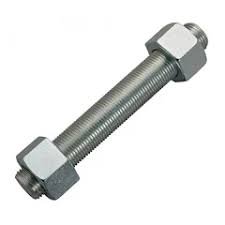
Installation: The stud is passed through the holes of two mating components (like two pipe flanges).
-
Torquing: Nuts are threaded onto both ends. As the nuts are tightened against the flange faces, the stud bolt is physically stretched (put under tension).
-
Clamping Force: This tension in the bolt creates a powerful, equal, and opposite clamping force that compresses the two flanges together, squeezing the gasket between them to form a leak-proof seal.
-
Uniformity: Because you can tighten nuts on both ends, stud bolts provide much more uniform pressure distribution compared to a headed bolt, which can “twist” or apply uneven force.
2. Primary Use
The primary use of a stud bolt is for High-Pressure and High-Temperature Bolted Joints.
They are preferred over standard hex bolts because:
-
Strength: They handle high tensile loads better than headed bolts.
-
Maintenance: If a nut becomes “frozen” due to rust, you can simply cut the nut off and replace it without having to replace the entire bolt or damage the flange.
-
Visual Safety: You can easily see if there is enough “thread engagement” (the bolt should protrude 2–3 threads past the nut) to ensure the connection is safe.
3. Common Applications
Stud bolts are the standard “building blocks” of heavy industrial infrastructure:
| Industry | Application |
| Oil & Gas | The most common fastener for Pipe Flanges in refineries and pipelines. |
| Pressure Vessels | Securing the “heads” or covers on large tanks, reactors, and heat exchangers. |
| Power Plants | Bolting together high-pressure steam lines and turbine housings. |
| Automotive | Wheel Studs (where the wheel is held onto the car) and engine cylinder head studs. |
| Construction | Anchor Bolts embedded in concrete to hold steel columns or heavy mac |