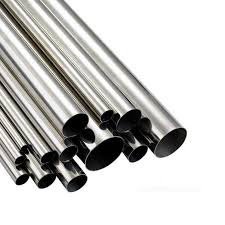
1. Working Principle
The “working principle” of stainless steel is a chemical phenomenon called Passivation:
-
The Passive Layer: When the chromium in the steel is exposed to oxygen, it forms an incredibly thin, invisible, and “passive” layer of Chromium Oxide on the surface.9
-
Self-Healing: If the pipe is scratched or damaged, the chromium reacts with oxygen in the air or water to instantly “re-heal” the protective layer. This prevents the iron in the steel from oxidizing (rusting).10
-
Manufacturing: Like other pipes, they are made via Seamless (piercing a hot billet) or Welded (rolling a sheet and TIG/Laser welding the seam) methods.11
2. Primary Use
The primary use of stainless steel pipe is the Hygienic and Safe Transport of Corrosive or Sensitive Fluids.
It is preferred over all other metals when:
-
Corrosion Resistance is mandatory (it can handle acids, alkalis, and salty air).12
-
Hygiene & Purity are required (it does not leach chemicals into the fluid and resists bacterial growth).13
-
Extreme Heat/Cold is present (it remains strong at $800\text{°C}$ and doesn’t become brittle at cryogenic temperatures).
-
Aesthetics matter (it is used in visible architectural designs).
3. Common Applications
Stainless steel pipes are essential for “high-purity” and “harsh-environment” industries:
| Industry | Application |
| Food & Beverage | Transporting milk, beer, and juices (easy to clean and sanitize). |
| Pharmaceutical | Sterile water systems and vaccine production lines (biocompatible). |
| Chemical/Petro | Handling highly reactive acids and hot gases in refineries. |
| Desalination | Transporting seawater in plants (Grade 316 prevents pitting from salt). |
| Marine | Boat railings, exhaust lines, and underwater piping. |
| Architecture | Modern handrails, building facades, and high-end structural supports. |