1. Working Principle
The working principle of a Weld Neck flange is centered on Stress Distribution and Flow Integrity:
-
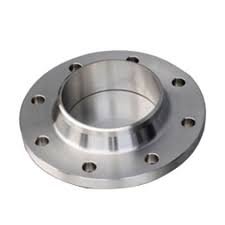
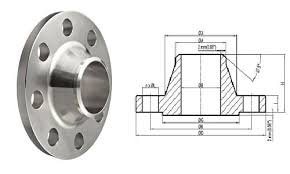
Stress Transfer: The long, tapered hub acts as a reinforcement. Instead of the stress being concentrated at the base of the flange (where the connection to the pipe is), the taper transfers the stress to the pipe itself. This makes it highly resistant to “dishing” or bending.
-
Smooth Transition: Because the bore matches the pipe exactly, the fluid moves from the pipe into the flange without hitting any “lips” or edges.9 This prevents erosion at the joint and minimizes pressure drops.
-
Reinforcement: The thickness of the hub provides extra metal to reinforce the joint against internal pressure and external forces like vibration or thermal expansion.
2. Primary Use
The primary use of a Weld Neck flange is for Critical, High-Pressure, and High-Temperature Services.
It is the preferred choice when:
-
Extreme Pressure is present (e.g., Class 900, 1500, or 2500).
-
Severe Temperature Fluctuations occur, causing the metal to expand and contract repeatedly.
-
Hazardous or Expensive Fluids are being transported, and the risk of a leak must be zero.
-
Vibration and Turbulence are high (the butt-weld is much stronger than a fillet weld used on other flange types).
3. Common Applications
Weld Neck flanges are the standard for “Heavy Industry” infrastructure:
| Industry | Application |
| Oil & Gas | High-pressure natural gas pipelines and offshore drilling platforms. |
| Petrochemical | Refineries where volatile chemicals are processed at high heat. |
| Power Generation | Main steam lines in nuclear and thermal power plants. |
| Cryogenics | Handling liquid nitrogen or LNG, where extreme cold makes other joints brittle. |
| Water Treatment | Large-diameter high-pressure pump discharge lines. |