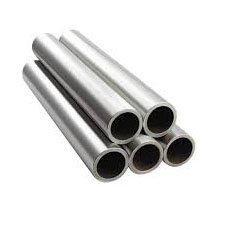
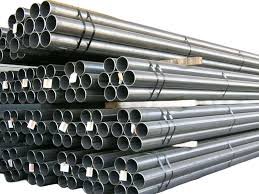

1. Working Principle
The working principle of alloy steel lies in Micro-Alloying:
-
Structural Reinforcement: The added elements change the crystal structure of the steel.7 For example, Molybdenum prevents “Creep”—a phenomenon where metal slowly deforms and stretches when under high stress and heat for long periods.8
-
Corrosion & Oxidation Resistance: Chromium forms a stable oxide layer (though not as thick as stainless steel) that protects the pipe from scaling and oxidation in high-heat environments.9
-
Heat Treatment Response: Alloy steels are highly responsive to heat treatments (like quenching and tempering), allowing engineers to “tune” the pipe to be either extremely hard or very flexible depending on the need.
2. Primary Use
The primary use of alloy steel pipe is for Extreme Temperature and High-Pressure (HTHP) Services.10
It is the material of choice when:
-
High Temperature Strength is needed (where carbon steel would lose its strength or melt).11
-
High Pressure is involved (the added alloys allow for thinner, lighter pipes that are just as strong as thick carbon steel).
-
Wear Resistance is required (handling abrasive materials).
3. Common Applications
Alloy steel pipes are the “high-performance” piping used in heavy industry:
| Industry | Application |
| Power Plants | Boiler tubes and superheater headers where temperatures exceed 500°C. |
| Petrochemical | Cracking furnaces and high-temperature reactors in refineries. |
| Energy | Heat exchangers where heat must be transferred efficiently under pressure. |
| Aerospace | Structural tubing for aircraft engines and hydraulic systems. |
| Oil & Gas | Deep-well drilling components that face extreme pressure and high sulfur content (H2S). |