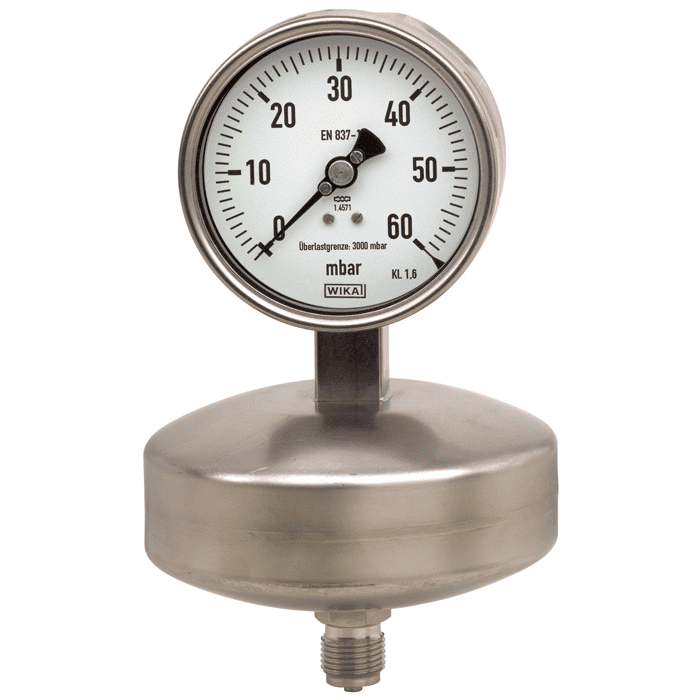
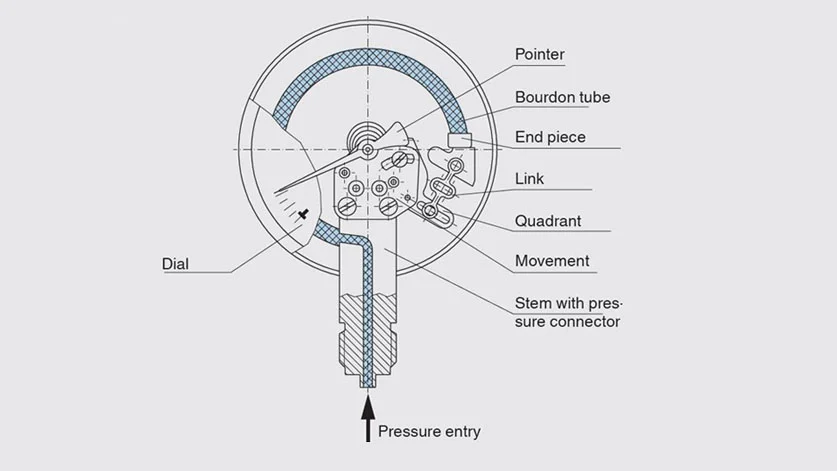
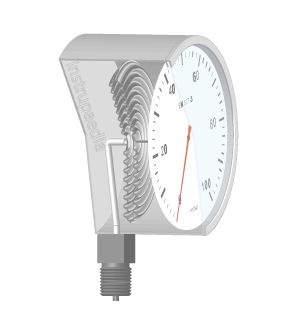

Mechanism: The working mechanism depends on the gauge type, but the most common is the Bourdon tube pressure gauge:
-
Pressure enters a curved metal tube (Bourdon tube).
-
As pressure increases, the tube tries to straighten.
-
This movement is transferred through mechanical linkages.
-
The linkage moves a pointer on a calibrated dial, indicating pressure.
Primary Use: The primary use of a pressure gauge is to monitor and control pressure in a system to:
-
Ensure safe operation
-
Prevent overpressure damage
-
Maintain efficient system performance
Common Application: Pressure gauges are widely used in:
-
Industrial systems (boilers, compressors, pipelines)
-
Hydraulic and pneumatic systems
-
Oil & gas industry
-
Chemical and pharmaceutical plants
-
Water supply and pumping systems
-
HVAC systems
-
Automobiles (tire pressure gauges)
-
Medical equipment (oxygen cylinders, blood pressure devices)