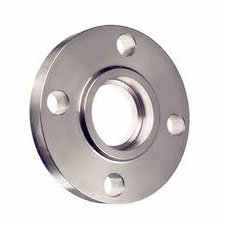

1. Working Principle
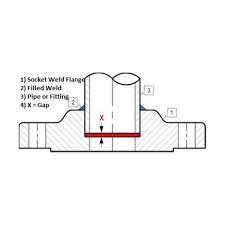
The working principle of a Socket Weld flange is based on the “Insert and Weld” method with a critical safety detail:
-
Insertion: The pipe is inserted into the socket until it hits the shoulder.
-
The Expansion Gap: Before welding, the pipe must be backed out slightly (about 1.6 mm or 1/16 inch). This gap is vital because it allows the pipe to expand during the welding process and thermal service without cracking the weld or the flange.
-
Sealing: A fillet weld is applied around the hub where the pipe meets the flange.
-
Flow Dynamics: Because the internal bore of the flange matches the pipe’s internal diameter, there is no “lip” or obstruction, resulting in better flow characteristics than a Slip-On flange.
2 Primary Use
The primary use of a Socket Weld flange is for Small-Diameter, High-Pressure Systems.
It is the preferred choice when:
-
Space is tight: It is more compact than a Weld Neck flange.
-
Internal Smoothness is needed: It prevents the turbulence and erosion caused by the internal gap found in Slip-On flanges.
-
High Strength is required: It is structurally superior to a Threaded flange but easier to install in small pipes than a Weld Neck flange.
3. Common Applications
Socket Weld flanges are the standard in specific technical environments:
| Industry | Application |
| Chemical Processing | High-pressure chemical lines where leakage must be strictly prevented. |
| Power Plants | Small-bore high-pressure steam lines and instrumentation lines. |
| Hydraulic Systems | High-pressure hydraulic fluid transport in heavy machinery. |
| Petrochemical | Secondary process lines carrying flammable or toxic fluids at high pressure. |
| Pneumatics | Specialized high-pressure air systems. |