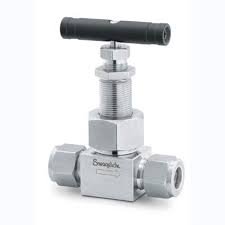
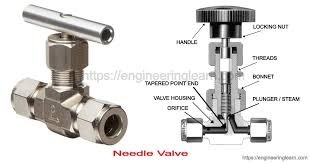
1. Working Principle
The needle valve operates on the principle of gradual orifice restriction:
-
Opening: As you turn the handle (usually counter-clockwise), the threaded stem slowly retracts the needle from the seat.11 This creates a tiny, precisely controlled gap.12 Because of the “vernier effect” (large movement of the handle results in tiny movement of the needle), you can adjust the flow in microscopic increments.
-
Closing: Turning the handle clockwise moves the needle into the seat. The tapered shape allows the needle to wedge into the opening for a “bubble-tight” seal, even with minimal hand pressure.
-
Flow Path: Similar to a globe valve, the fluid must turn 90 degrees to pass through the seat, which results in a significant pressure drop.
2. Primary Use
The primary use of a needle valve is Precise Metering and Instrumentation Protection.
It is used specifically when:
-
Fine Throttling is required (e.g., maintaining a constant, tiny flow rate for a chemical reaction).
-
Protecting Delicate Gauges: They are installed upstream of pressure gauges to “dampen” pressure surges and prevent the gauge needle from slamming and breaking.
-
Vacuum Systems: They are excellent for the precise bleeding of air or gas into a vacuum chamber.
3. Common Applications
You will find needle valves in “laboratory” or “high-tech” settings rather than heavy industrial waste lines:
| Industry | Application |
| Instrumentation | Isolation and calibration of pressure gauges, flow meters, and switches. |
| Laboratory/R&D | Controlling the flow of gases in chromatography or chemical dosing in experiments. |
| Automotive | Controlling the “idle” fuel flow in older carburetors. |
| Oil & Gas | Sampling points where a small amount of high-pressure crude or gas needs to be safely drawn for testing. |
| Pneumatics | Speed control for small air cylinders by regulating the air exhaust. |