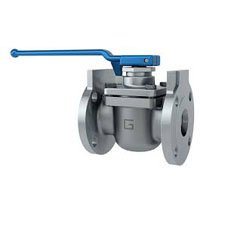
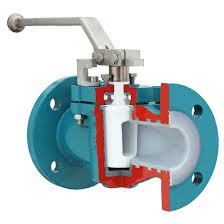

1. Working Principle
Like the ball valve, the plug valve operates with a 90-degree (Quarter-Turn) rotation:
-
Opening: When the handle is turned, the plug rotates until the internal passage aligns with the inlet and outlet ports of the valve body. This provides a straight-through flow path.
-
Closing: Rotating the handle 90 degrees turns the solid face of the plug toward the flow. Because the seating surface area is much larger than a ball valve, it creates a very robust, leak-proof seal.
-
Wiping Action: As the plug rotates, its edges “wipe” the seat. This helps clear away any debris or solids that might be stuck in the valve, preventing damage to the seal.
2. Primary Use
The primary use of a plug valve is Heavy-Duty Isolation, especially for “dirty” or “extreme” fluids.
It is chosen over other valves for:
-
Slurry Handling: Its wiping action makes it excellent for fluids containing suspended solids (mud, sewage, etc.).
-
Diverting Flow: Multi-port versions are used to redirect flow from one pipe to another without needing a complex manifold of multiple valves.
-
High-Pressure/High-Temperature: Their robust, simple design allows them to handle extreme conditions where a ball valve’s soft seats might fail.
3. Common Applications
Plug valves are the standard in industries dealing with thick or corrosive materials:
| Industry | Application |
| Oil & Gas | Crude oil production, gas gathering systems, and “upstream” drilling operations (handling mud). |
| Chemical Processing | Handling highly corrosive acids or toxic chemicals (especially lined plug valves). |
| Wastewater | Moving sludge and sewage through treatment plants where grit would damage other valves. |
| Mining | Transporting abrasive mineral slurries. |
| Refineries | Vacuum systems and high-temperature hydrocarbon services. |