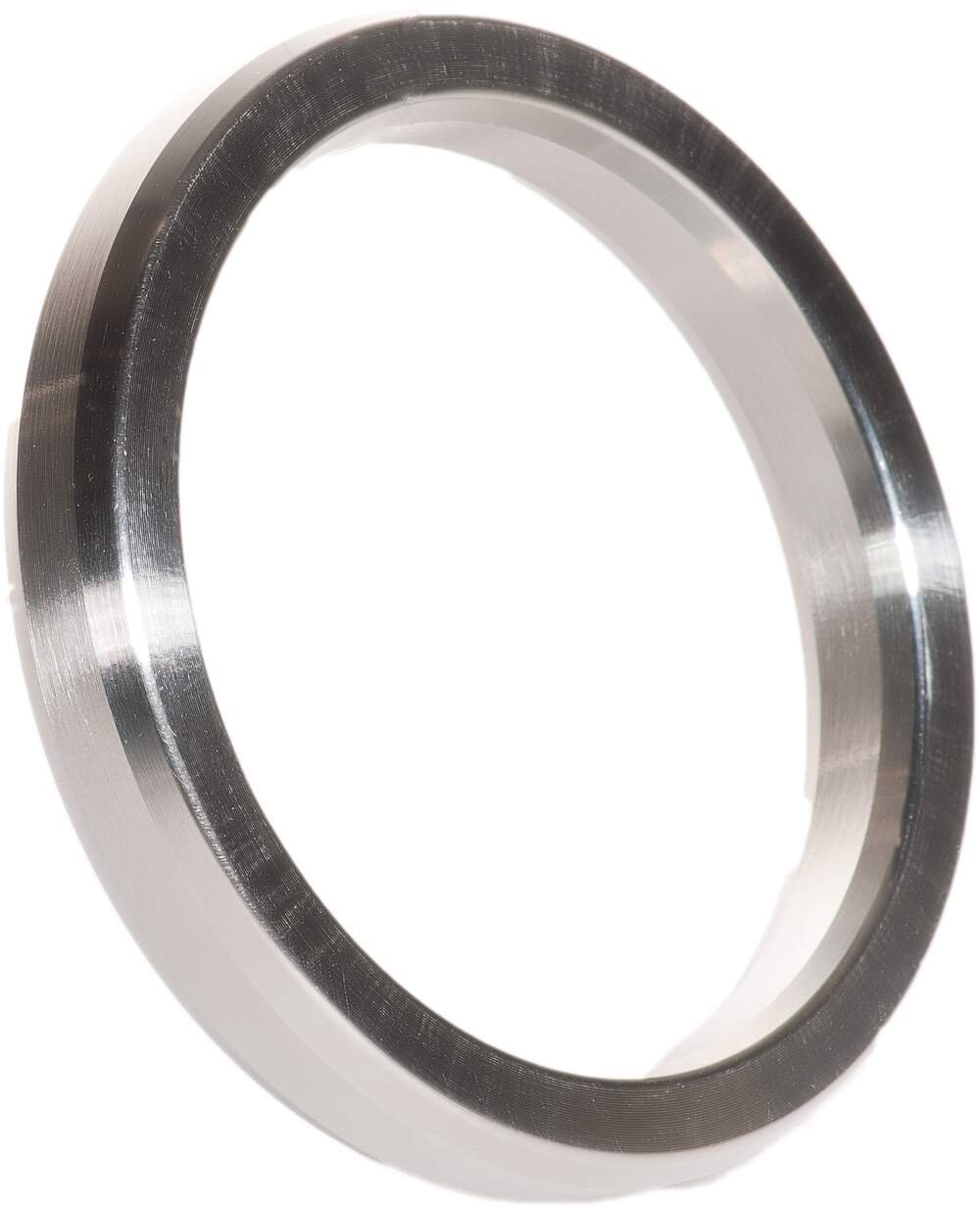
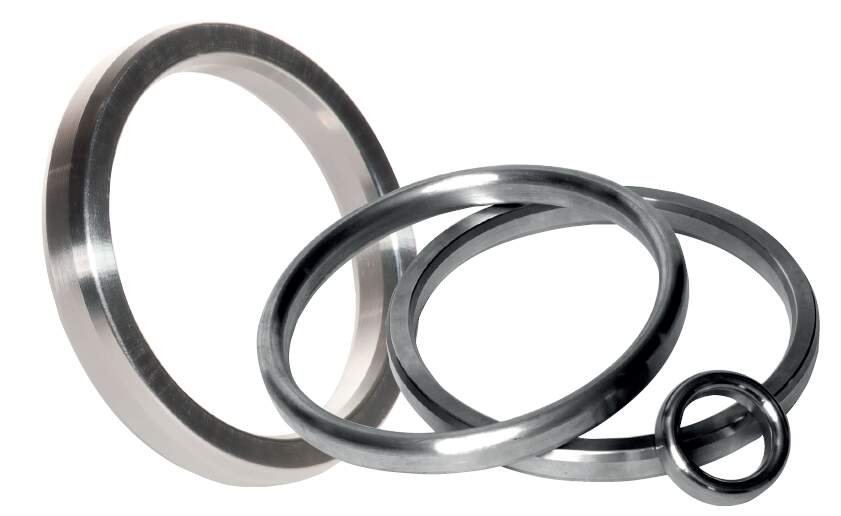
Working Principle: The mechanism relies on precision-machined grooves and metallic deformation:
- Grooved Flange Design
- RTJ flanges have machined circular grooves on their mating faces.
- The ring gasket sits within these grooves, positioned between the two flange faces.
- Metal-to-Metal Contact
- As the flange bolts are tightened, the ring is compressed between the groove walls.
- The ring’s cross-sectional profile (octagonal or oval) is slightly larger than the groove, causing controlled deformation.
- Cold Flow Sealing
- Under bolt load, the metal ring “cold flows” slightly, plastically deforming to fill microscopic surface irregularities in the groove.
- This creates a tight, metal-to-metal seal without relying on a soft filler material.
- Self-Energizing Effect
- Internal system pressure pushes against the ring, increasing contact force against the groove walls.
- This self-energizing action enhances sealing effectiveness as pressure rises, rather than weakening it.
Primary Use: The primary use of a Ring Type Joint gasket is to provide an extremely reliable, high-integrity seal in flanged connections subjected to very high pressure, high temperature, and demanding service conditions where soft or semi-metallic gaskets would fail.
Common Applications: Ring Type Joint gaskets are widely used in:
- Oil and gas wellhead equipment and Christmas trees
- High-pressure pipelines and pipeline flanges
- Subsea and offshore drilling equipment
- Refinery and petrochemical high-pressure systems
- Steam boilers and high-pressure steam lines
- Compressor and pump flanged connections
- API 6A/6B rated pressure equipment
- Critical valve and manifold connections in upstream oil & gas